


Many organisations recognise the need to address psychosocial risk. Increased awareness, evolving expectations, and regulatory focus have pushed the issue firmly onto the agenda.
But while most know they need to act, fewer are confident they’re doing it effectively.
The default approach is often a survey. A validated tool is deployed, results are analysed, and key themes are identified – workload, support, role clarity. While useful, this approach can leave a critical gap:
Does it truly reflect the reality of the work? In complex, high-pressure environments, the answer is often no.
When Risk Is Inherent
In many roles, psychological strain builds gradually through the work itself. A judge completes a multi-week trial involving distressing material, then returns immediately to a full list the following week. On paper, the workload appears manageable. In practice, there has been little opportunity to decompress, and the impact of that exposure continues to carry forward.
Similar patterns can be seen across other high-exposure roles. A paramedic attending repeated critical incidents, or a social worker managing complex and emotionally charged cases, may not point to a single moment as the source of pressure. It is the accumulation over time that matters.
In these environments, the focus shifts from trying to remove risk altogether to understanding how it builds (or spikes) and how it can be managed more effectively.
Research reflects this. In professions such as healthcare, emergency services, and frontline care, outcomes are influenced by how work is structured and experienced in practice[1]. Factors such as workload, level of control, and access to support all play a role, but their impact depends on how they combine in real situations.
In one recent engagement, we worked with an organisation operating in this type of environment. Earlier assessments had identified general areas such as workload and support, but they did not fully explain how these pressures were being experienced or why they were affecting some individuals more than others.
A More Targeted Approach
To better understand the risk, we combined survey data with in-depth, confidential interviews. This allowed participants to speak openly about what was actually impacting them in their day-to-day work.
We then analysed the findings using a structured framework that distinguishes between three key drivers: 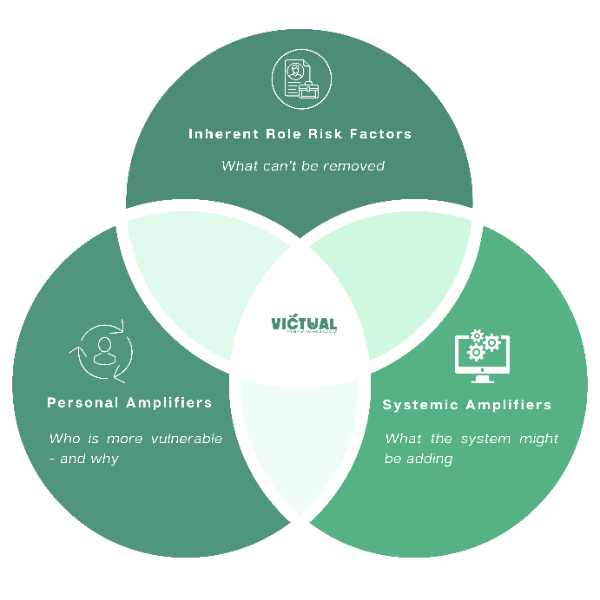
- Core Risk Factors – inherent aspects of the role, such as workload, dealing with aggressive customers or exposure to traumatic material
- Personal Amplifiers – individual or situational factors that increase vulnerability (e.g. isolation, experience level)
- Systemic Amplifiers – organisational and cultural conditions that can intensify risk, including systems, processes, leadership practices, and workplace norms
This approach moves beyond identifying what the risks are, to understanding how they operate.
Importantly, research shows that interventions targeting work design and organisational conditions are more effective than those focused solely on individual coping strategies[2]. Yet many organisations continue to rely heavily on reactive supports such as EAP or resilience training.
Without deeper insight, organisations can invest in solutions that don’t meaningfully reduce risk, because they are not aligned to how that risk actually manifests.
What We Found – And What It Enables
This deeper analysis provided clearer, more actionable insights.
While exposure to challenging material was expected, it was the cumulative effect over time, combined with limited recovery opportunities, that was driving strain.[3]
Support services were available, but largely reactive. There was limited visibility over who might be at increased risk, and few mechanisms to intervene early.
These findings are consistent with broader industry evidence. Research across police and emergency services has shown that organisational culture, leadership, and support structures play a critical role in shaping psychological outcomes – often as much as the work itself.[4]
By contrast, a more structured and contextual approach enables organisations to:
- Identify where risk is most likely to emerge
- Target support more effectively
- Improve visibility of workload and exposure
- Intervene earlier, before issues escalate
In high-risk environments, structured peer-based approaches have also been developed to identify and respond to trauma exposure early, reinforcing the value of proactive, system-level interventions.[5]
A Better Way Forward
Psychosocial risk is often assessed in broad terms but experienced in highly specific ways.
Where risk is inherent to the role, managing it effectively requires more than measurement. It requires understanding how different factors interact and amplify each other in practice.
A survey can tell you that risk exists but understanding how that risk works is what allows you to manage it effectively.
For many organisations, the next step isn’t more data – it’s better understanding.
If this reflects your environment, it may be worth exploring what a more tailored approach to psychosocial risk could look like in practice.
Contact us for more information and enquiries.