


Australia is not yet in a declared national fuel emergency. Food remains on shelves, distribution centres are operating, and the National Liquid Fuel Emergency Response Plan (NLFERP) remains formally at Phase 2.
However, for food and beverage businesses, that status is misleading. Australia is operating at the upper end of Phase 2, where escalation risk is elevated but not predetermined. The next 7–14 days represent a narrow preparation window. Decisions taken by boards now materially reduce the risk of disruption if conditions deteriorate.
This article sets out the current diesel situation as it applies to the food system, explains why diesel is the binding constraint, confirms why the primary impact on food and grocery will be transport rather than production, and outlines what businesses must do now to prepare.
The Current Position
At time of publication, Australia remains under enhanced coordination settings. Emergency tools such as reserve releases and Minimum Stockholding Obligation relief are active, and voluntary industry cooperation is still functioning. Importantly, mandatory allocation powers have not been triggered, and there is no formal declaration of a national fuel emergency.
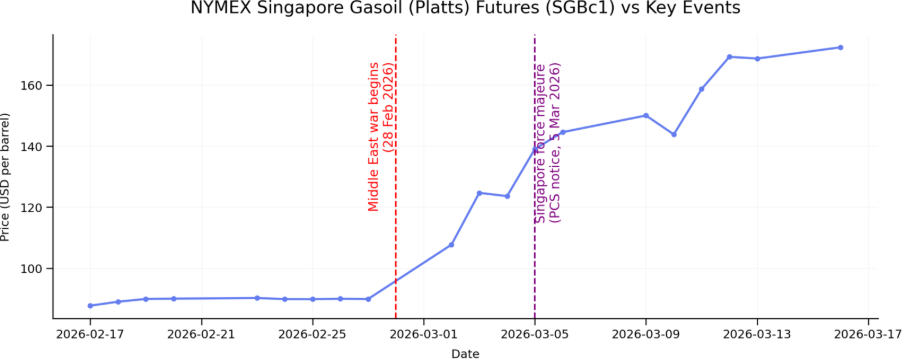
The graph below highlights why we need to take this seriously. Singapore refineries represent 30-40% of Australia’s diesel supply. The price of gasoil (basically diesel) in Singapore is plotted below. On the 28th February the middle east conflict began. Less than a week later, Singapore refineries activated force majeure clauses in their contracts indicating they would not meet customer orders. This includes Australian distributors. The situation has only worsened since then. Other Asian refineries have since also activated similar clauses, and the gasoil price continues to rise.
For food and beverage businesses, we emphasise this is a time of preparation, not crisis. Availability risk in this phase is a reliability issue. Short term and regional outages will occur sporadically and unpredictably.
Why Diesel Is the Critical Constraint for the Food System
For food and beverage businesses, diesel is not an abstract input — it is the enabler of the entire supply chain.
Diesel underpins:
- linehaul and last mile grocery freight,
- refrigerated and frozen transport,
- livestock movements and feed delivery,
- inbound raw material logistics,
- outbound finished goods distribution,
- backup generation for cold storage and processing facilities,
- port, terminal, and distribution centre operations.
Diesel cannot be substituted at scale in the short term. Electrification, alternative fuels, or modal shifts do not provide near-term resilience. When diesel supply tightens, the food system’s exposure is real.
Current market signals reinforce this. Whilst the spike in price in global gasoil markets indicates that immediate diesel delivery is being priced at a significant premium, it is expected that later supply is expected to normalise. This tells us that the problem is timing and logistics, not long-term global shortage — but it also means that buffers are being drawn down rapidly, leaving little tolerance for disruption.
What’s Considered Essential?
Under the Liquid Fuel Emergency Act 1984, “essential users” are those who carry out activities that are necessary to prevent serious damage to the health, safety, or welfare of the community. Essentiality is therefore function based, not industry based. [dcceew.gov.au],
The National Liquid Fuel Emergency Response Plan (NLFERP) determines who receives priority access to fuel if mandatory allocation is triggered in Phase 3.
Fuel is prioritised to activities, not businesses or industries, and only where loss of fuel would cause immediate and serious harm to the community.
Food, agriculture, grocery retail, and logistics are not listed as Essential Users as industries under NLFERP. [energy.gov.au] However, specific activities within the food system may be prioritised if — and only if — they meet the harm prevention test.
How this works in practice is still to be determined, however what is clear is that those businesses who have a good understanding of the different elements of their business, the fuel that is used, and can mount a position that they are supporting the health, safety and welfare of the community will be best placed to navigate a Phase 3 position.
What Actions Should We Take Now
In this preparation phase there are a few proactive steps businesses should be taking:
1. Plan – Don’t Panic
Firstly, Boards and Senior Management need to be calm and show that they are in control. This is a time to take the situation seriously and plan for broader restrictions and understand how government intervention is likely to impact your business.
2. Lock Assumptions
Don’t assume that food and beverage industry will be considered essential. This is not COVID!
3. Define Minimum Viable Operations (MVO)
Start to think what an operation may look like on a minimum level. What are the:
- Must Do activities (to prevent harm to food availability, safety, welfare),
- Deferrable activities,
- Stop Early activities that will cease automatically if fuel tightens,
- Minimum diesel required to prevent immediate harm (measured in days, not months).
For food businesses, MVO is about preventing harm, not protecting revenue.
4. Engage Early with Stakeholders
Once you have a good understanding of what your MVO is then engage early with your critical suppliers and customers to proactively work with them on how to manage the supply interruption.
In this respect the emphasis of Phase 2 is on this collaboration to manage the supply interruption, and so this is something that we should all be actively doing and government will only look positively on organisations doing this.
Dusting Off the BCP
The immediate thought might be to pull out the BCP to have a review, and whilst it will be a useful document to help you step through your processes, we are actually planning on which processes to purposefully interrupt, rather than helping to reinstate processes that have been interrupted. In fact, reverse engineering your BCP to fit this scenario is a better way of looking at what’s required in this situation.
The Takeaway for Food and Beverage Industry
At the time of publication, Australia is not yet in a declared fuel emergency. But diesel supply conditions are tight enough that transport reliability for food is the key risk, not production capacity.
For food and beverage businesses, the next 14-21 days are about locking minimum viable food operations, validating diesel buffers against harm prevention needs, and maintaining calm, disciplined readiness. If formal escalation begins, it will happen quickly, discretion disappears and preparation time is already over.
In this window, preparedness — not prediction — is the smart strategy.
Contact us if you’re interested in learning more about reverse engineering your BCP.